

20th Floor, Tamkeen Tower, Riyadh, KSA

Efforts to address the crisis have led to a 45% increase in energy efficiency investments since 2020, with 2023 marking a pivotal moment as global momentum aims to double the rate of efficiency progress. This concerted effort could potentially cut energy bills in advanced countries by one-third and contribute to 50% of CO2 reductions by 2030. A significant catalyst in achieving energy efficiency goals for dense urban environments is the adoption and enhancement of District Cooling Systems.
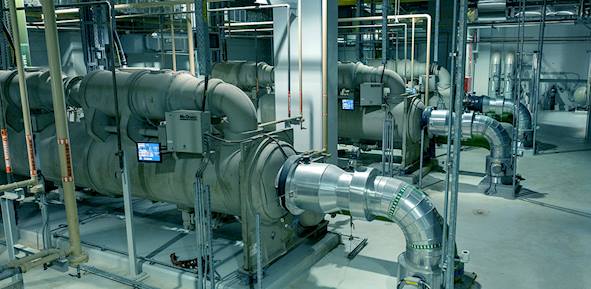
District Cooling is a sustainable solution that revolutionizes the way we handle air conditioning and refrigeration needs. Unlike traditional air conditioning systems that rely on individual units for cooling, District Cooling centralizes the process, serving entire districts or communities through a network of chilled water pipes. Each building, equipped with its heat exchanger receives chilled water for cooling purposes. The closed-loop system ensures sustainability, as water is fed back to the cooling plant for re-cooling and redistribution.
The International Energy Agency (IEA) anticipates an 80% increase in cooling efficiency by 2050, driven by technological advancements. However, the sheer volume of additional demand poses a substantial challenge. District cooling emerges as a strategic solution to counter this challenge, going beyond technological improvements by aggregating demand and employing highly efficient technologies.
This becomes particularly pertinent in regions like the Middle East, where soaring temperatures demand a consistent commitment to efficient cooling solutions. District cooling steps up to the challenge by offering a more reliable and energy-conscious alternative. District cooling systems consume 20 - 30% less power than the most efficient conventional cooling solutions and 40– 60% less power than average conventional cooling systems. This efficiency not only translates into cost savings but also helps electricity providers reduce peak power demand through the concept of "peak cooling demand shaving."
The potential impact of across-the-board District Cooling adoption is substantial. Estimates suggest a reduction in energy consumption by up to 5,000 terawatt-hours over the next 16 years, translating to over $1 trillion in savings by 2035. These projections, based on energy prices of $0.20 per kilowatt-hour, underscore the economic and environmental benefits of embracing District Cooling on a global scale. With a target of 350 million connections in cities worldwide by 2030, these networks play a crucial role not only in achieving energy efficiency but also in delivering energy security and reducing dependence on energy imports.
In conclusion, District Cooling stands as a transformative force in the pursuit of global energy efficiency. As countries strive to meet ambitious goals, the adoption and enhancement of District Cooling Systems offers a practical and sustainable solution. By cutting costs, reducing overall energy consumption, and contributing to a greener future, District Cooling takes the center stage in shaping a more energy-efficient and sustainable urban landscape.